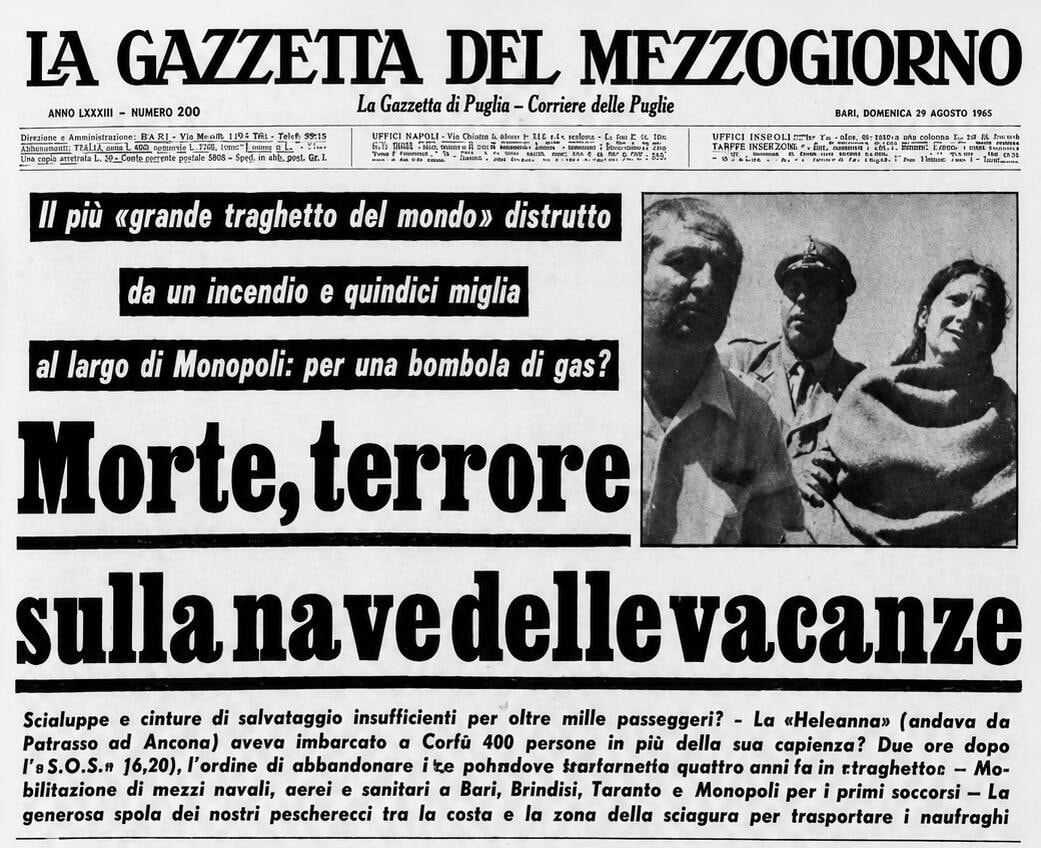
Descrizione
Il 28 agosto 1971, a circa 15 miglia da Monopoli, un drammatico incendio devastò il traghetto greco Heleanna, proveniente da Patrasso e diretto ad Ancona. A bordo si trovavano oltre 1.100 passeggeri e circa 200 mezzi. Le fiamme, divampate nei locali della cucina intorno alle 5.30 del mattino, si propagarono rapidamente trasformando il viaggio in una tragedia: 25 persone persero la vita, 16 risultarono disperse e 271 furono ferite.
L’SOS lanciato dalla nave mobilitò immediatamente i soccorsi aeronavali provenienti da Brindisi, Bari, Taranto, Grottaglie e Monopoli. In quelle ore drammatiche, quando il mare era diventato teatro di paura e disperazione, furono soprattutto i pescatori monopolitani a distinguersi per coraggio, prontezza e spirito di sacrificio.
I motopesca “Laura”, “Madonna della Madia” e “Angela Danese”, insieme alla motobarca da pesca “San Cosimo”, raggiunsero la zona della tragedia partecipando alle operazioni di salvataggio dei naufraghi. Uomini abituati al mare, ma chiamati quella mattina ad affrontare una situazione eccezionale, si lanciarono nelle operazioni di soccorso mettendo a rischio la propria vita per salvare quella degli altri.
Il valore di quegli uomini fu riconosciuto ai massimi livelli dello Stato. Il Presidente della Repubblica Giuseppe Saragat, interpretando la gratitudine del Paese per l’efficacissima opera prestata durante i soccorsi, dispose il conferimento dell’onorificenza di Cavaliere Ufficiale dell’Ordine al Merito della Repubblica Italiana ad alcuni componenti degli equipaggi.
Furono insigniti Giuseppe Ruggiero, capobarca della Laura; Mario Civetta, marinaio della Laura; Giuseppe Gentile, capobarca della Madonna della Madia; Rocco Comes, marinaio motorista della Madonna della Madia; Nicola Ranieri, della motobarca San Cosimo; Raffaele Danese e Filippo Danese, dell’Angela Danese.
Alle operazioni di soccorso partecipò anche il peschereccio “Nuova Vittoria” di Cosimo Tarantino, monopolitano di stanza a Brindisi, impegnato nelle attività di soccorso e nella ricerca dei dispersi.
Ma quella del 28 agosto non fu soltanto la storia di una tragedia in mare. Fu anche la storia di un’intera comunità che seppe reagire con umanità e solidarietà.
Mentre in mare proseguivano le operazioni di salvataggio, Monopoli si mobilitò per accogliere i superstiti. Cittadini, associazioni e privati misero a disposizione mezzi, indumenti, coperte e ogni forma di assistenza necessaria. I naufraghi furono accolti, soccorsi e accompagnati nei giorni successivi con una straordinaria partecipazione della popolazione.
Quella solidarietà non rimase senza riconoscimento.
Il 19 aprile 1972, alla città di Monopoli fu conferita la Medaglia d’Argento al Merito Civile, proprio per l’opera prestata in occasione della tragedia dell’Heleanna. La motivazione ricordò l’altissimo spirito di civismo e la sensibile solidarietà umana dimostrati dalla popolazione nel soccorrere e assistere amorevolmente, per più giorni, i numerosi naufraghi.
È questo il significato più profondo della memoria del 28 agosto 1971: ricordare le vittime, custodire il dolore di una tragedia che segnò profondamente il nostro mare e la nostra città, ma anche raccontare il coraggio di uomini che non esitarono ad andare incontro al pericolo e la generosità di una comunità che seppe aprire le proprie porte a chi aveva perso tutto.
A ricordare quella straordinaria storia sul Molo Margherita, nei pressi del Castello Carlo V, insiste una lapide dedicata alla tragedia e al bassorilievo commemorativo, nel luogo che conserva il ricordo delle vittime e dell’eroismo dei soccorritori monopolitani.
Il 28 agosto 1971 appartiene alla storia di Monopoli.
Una storia fatta di dolore e memoria, ma anche di coraggio, solidarietà e umanità.
Perché ricordare significa non lasciare che il tempo cancelli i nomi delle vittime e il gesto di chi, quel giorno, scelse di mettere a rischio la propria vita per salvare quella degli altri.
-------------------------------------
ENGLISH
On 28 August 1971, approximately 15 nautical miles off the coast of Monopoli, a dramatic fire devastated the Greek ferry Heleanna, sailing from Patras to Ancona. On board were more than 1,100 passengers and around 200 vehicles. The flames broke out in the kitchen area at around 5:30 a.m. and spread rapidly, turning the journey into a tragedy: 25 people lost their lives, 16 were reported missing and 271 were injured.
The SOS sent by the ship immediately mobilized air and naval rescue services from Brindisi, Bari, Taranto, Grottaglie and Monopoli. During those dramatic hours, when the sea had become a scene of fear and despair, it was above all the fishermen of Monopoli who distinguished themselves through their courage, readiness and spirit of sacrifice.
The fishing vessels “Laura”, “Madonna della Madia” and “Angela Danese”, together with the fishing boat “San Cosimo”, reached the scene of the tragedy and took part in the rescue operations. Men accustomed to the sea, but called upon that morning to face an exceptional situation, threw themselves into the rescue efforts, putting their own lives at risk to save the lives of others.
The courage of these men was recognized at the highest levels of the State. President of the Republic Giuseppe Saragat, expressing the nation’s gratitude for the highly effective work carried out during the rescue operations, ordered that some members of the crews be awarded the distinction of Knight Grand Officer of the Order of Merit of the Italian Republic.
Those honored were Giuseppe Ruggiero, skipper of the Laura; Mario Civetta, sailor of the Laura; Giuseppe Gentile, skipper of the Madonna della Madia; Rocco Comes, engineer and sailor of the Madonna della Madia; Nicola Ranieri, of the fishing boat San Cosimo; and Raffaele Danese and Filippo Danese, of the Angela Danese.
The fishing vessel “Nuova Vittoria”, owned by Cosimo Tarantino, a native of Monopoli based in Brindisi, also took part in the rescue operations, assisting survivors and searching for those missing.
But the events of 28 August were not only the story of a tragedy at sea. They were also the story of an entire community that responded with humanity and solidarity.
While rescue operations continued at sea, Monopoli mobilized to welcome the survivors. Citizens, associations and private individuals made vehicles, clothing, blankets and every form of necessary assistance available. The survivors were welcomed, helped and accompanied in the following days, thanks to the extraordinary participation of the local population.
That solidarity did not go unrecognized.
On 19 April 1972, the city of Monopoli was awarded the Silver Medal for Civil Merit, specifically for the assistance provided on the occasion of the Heleanna tragedy. The official citation recalled the exceptional civic spirit and profound human solidarity shown by the population in rescuing and lovingly assisting the numerous survivors for several days.
This is the deepest meaning of remembering 28 August 1971: to commemorate the victims, preserve the memory of a tragedy that profoundly marked our sea and our city, but also to tell the story of the courage of men who did not hesitate to confront danger and the generosity of a community that opened its doors to those who had lost everything.
A memorial plaque dedicated to the tragedy and a commemorative bas-relief on Molo Margherita, near Carlo V Castle, keep alive the memory of this extraordinary story, in a place that preserves the memory of the victims and the heroism of the rescuers from Monopoli.
28 August 1971 is part of the history of Monopoli.
A history marked by pain and remembrance, but also by courage, solidarity and humanity.
Because remembering means not allowing time to erase the names of the victims or the actions of those who, on that day, chose to put their own lives at risk to save the lives of others.
-------------------------------------
DEUTSCH
Am 28. August 1971, etwa 15 Seemeilen vor Monopoli, verwüstete ein dramatischer Brand die griechische Fähre Heleanna, die von Patras nach Ancona unterwegs war. An Bord befanden sich mehr als 1.100 Passagiere und rund 200 Fahrzeuge. Das Feuer brach gegen 5.30 Uhr morgens im Küchenbereich aus und breitete sich rasch aus. Die Überfahrt wurde zu einer Tragödie: 25 Menschen verloren ihr Leben, 16 wurden vermisst und 271 verletzt.
Der von dem Schiff abgesetzte SOS-Ruf mobilisierte sofort die Luft- und Seerettungskräfte aus Brindisi, Bari, Taranto, Grottaglie und Monopoli. In diesen dramatischen Stunden, als das Meer zum Schauplatz von Angst und Verzweiflung geworden war, zeichneten sich vor allem die Fischer aus Monopoli durch Mut, Entschlossenheit und Opferbereitschaft aus.
Die Fischerboote „Laura“, „Madonna della Madia“ und „Angela Danese“ sowie das Fischerboot „San Cosimo“ erreichten den Unglücksort und beteiligten sich an den Rettungsmaßnahmen. Männer, die an das Meer gewöhnt waren, mussten an jenem Morgen eine außergewöhnliche Situation bewältigen. Sie stürzten sich in die Rettungsaktionen und setzten dabei ihr eigenes Leben aufs Spiel, um das Leben anderer zu retten.
Der Mut dieser Männer wurde auf höchster staatlicher Ebene gewürdigt. Der Präsident der Italienischen Republik Giuseppe Saragat verlieh in Anerkennung und zum Ausdruck der Dankbarkeit des Landes für den äußerst wirksamen Einsatz bei den Rettungsarbeiten einigen Besatzungsmitgliedern die Auszeichnung Großoffizier des Verdienstordens der Italienischen Republik.
Ausgezeichnet wurden Giuseppe Ruggiero, Schiffsführer der Laura; Mario Civetta, Matrose der Laura; Giuseppe Gentile, Schiffsführer der Madonna della Madia; Rocco Comes, Motorist und Matrose der Madonna della Madia; Nicola Ranieri vom Fischerboot San Cosimo sowie Raffaele Danese und Filippo Danese von der Angela Danese.
Auch das Fischerboot „Nuova Vittoria“ von Cosimo Tarantino, einem aus Monopoli stammenden Fischer, der in Brindisi stationiert war, beteiligte sich an den Rettungsmaßnahmen und an der Suche nach den Vermissten.
Doch der 28. August war nicht nur die Geschichte einer Tragödie auf See. Er war auch die Geschichte einer ganzen Gemeinschaft, die mit Menschlichkeit und Solidarität zu handeln wusste.
Während auf See die Rettungsaktionen fortgesetzt wurden, mobilisierte sich Monopoli, um die Überlebenden aufzunehmen. Bürgerinnen und Bürger, Vereine und Privatpersonen stellten Fahrzeuge, Kleidung, Decken und jede notwendige Form der Unterstützung zur Verfügung. Die Schiffbrüchigen wurden aufgenommen, versorgt und in den darauffolgenden Tagen begleitet – getragen von einer außergewöhnlichen Anteilnahme der Bevölkerung.
Diese Solidarität blieb nicht ohne Anerkennung.
Am 19. April 1972 wurde der Stadt Monopoli die Silbermedaille für zivile Verdienste verliehen, ausdrücklich für die Hilfe, die anlässlich der Tragödie der Heleanna geleistet worden war. In der Begründung wurden der außergewöhnlich ausgeprägte Bürgersinn und die große menschliche Solidarität hervorgehoben, mit denen die Bevölkerung die zahlreichen Schiffbrüchigen rettete und sie mehrere Tage lang fürsorglich betreute.
Darin liegt die tiefste Bedeutung des Gedenkens an den 28. August 1971: die Opfer in Erinnerung zu bewahren, den Schmerz einer Tragödie zu bewahren, die unser Meer und unsere Stadt tief geprägt hat, aber auch den Mut jener Männer zu erzählen, die nicht zögerten, sich der Gefahr entgegenzustellen, und von der Großzügigkeit einer Gemeinschaft, die ihre Türen für Menschen öffnete, die alles verloren hatten.
An diese außergewöhnliche Geschichte erinnert auf dem Molo Margherita, in der Nähe des Castello Carlo V, eine Gedenktafel für die Tragödie sowie ein Gedenk-Basrelief. Dieser Ort bewahrt die Erinnerung an die Opfer und an den Heldenmut der Rettungskräfte aus Monopoli.
Der 28. August 1971 gehört zur Geschichte von Monopoli.
Eine Geschichte von Schmerz und Erinnerung, aber auch von Mut, Solidarität und Menschlichkeit.
Denn Erinnern bedeutet, nicht zuzulassen, dass die Zeit die Namen der Opfer und die Tat jener Menschen auslöscht, die sich an jenem Tag entschieden, ihr eigenes Leben zu riskieren, um das Leben anderer zu retten.
-------------------------------------
SPANISH
El 28 de agosto de 1971, aproximadamente a 15 millas náuticas de la costa de Monopoli, el ferry griego Heleanna, que navegaba de Patras a Ancona, sufrió un devastador incendio. A bordo viajaban más de 1.100 pasajeros y alrededor de 200 vehículos. Las llamas se originaron en la zona de la cocina hacia las 5:30 de la madrugada y se propagaron rápidamente, convirtiendo el viaje en una tragedia: 25 personas perdieron la vida, 16 fueron dadas por desaparecidas y 271 resultaron heridas.
La señal de SOS enviada por el barco movilizó inmediatamente a los servicios de rescate aéreo y naval de Brindisi, Bari, Taranto, Grottaglie y Monopoli. Durante aquellas dramáticas horas, cuando el mar se había convertido en un escenario de miedo y desesperación, fueron sobre todo los pescadores de Monopoli quienes destacaron por su valentía, rapidez de reacción y espíritu de sacrificio.
Los pesqueros “Laura”, “Madonna della Madia” y “Angela Danese”, junto con la embarcación pesquera “San Cosimo”, llegaron al lugar de la tragedia y participaron en las operaciones de rescate. Hombres acostumbrados al mar, pero llamados aquella mañana a enfrentarse a una situación excepcional, se lanzaron al rescate poniendo en peligro sus propias vidas para salvar las de los demás.
El valor de estos hombres fue reconocido al más alto nivel del Estado. El presidente de la República, Giuseppe Saragat, expresando el agradecimiento de la nación por la labor altamente eficaz realizada durante las operaciones de rescate, dispuso que algunos miembros de las tripulaciones fueran distinguidos con el título de Caballero Gran Oficial de la Orden del Mérito de la República Italiana.
Los homenajeados fueron Giuseppe Ruggiero, patrón del Laura; Mario Civetta, marinero del Laura; Giuseppe Gentile, patrón del Madonna della Madia; Rocco Comes, maquinista y marinero del Madonna della Madia; Nicola Ranieri, de la embarcación pesquera San Cosimo; y Raffaele Danese y Filippo Danese, de la Angela Danese.
El pesquero “Nuova Vittoria”, propiedad de Cosimo Tarantino, natural de Monopoli y residente en Brindisi, también participó en las operaciones de rescate, prestando ayuda a los supervivientes y colaborando en la búsqueda de las personas desaparecidas.
Pero los acontecimientos del 28 de agosto no fueron únicamente la historia de una tragedia en el mar. Fueron también la historia de toda una comunidad que respondió con humanidad y solidaridad.
Mientras las operaciones de rescate continuaban en el mar, Monopoli se movilizó para acoger a los supervivientes. Ciudadanos, asociaciones y particulares pusieron a disposición vehículos, ropa, mantas y todo tipo de ayuda necesaria. Los supervivientes fueron recibidos, asistidos y acompañados durante los días siguientes gracias a la extraordinaria participación de la población local.
Aquella solidaridad no pasó desapercibida.
El 19 de abril de 1972, la ciudad de Monopoli recibió la Medalla de Plata al Mérito Civil, precisamente por la asistencia prestada con ocasión de la tragedia del Heleanna. La concesión reconocía el excepcional espíritu cívico y la profunda solidaridad humana demostrados por la población al rescatar y asistir con afecto a los numerosos supervivientes durante varios días.
Este es el significado más profundo de recordar el 28 de agosto de 1971: conmemorar a las víctimas, preservar la memoria de una tragedia que marcó profundamente nuestro mar y nuestra ciudad, pero también contar la historia de la valentía de unos hombres que no dudaron en enfrentarse al peligro y de la generosidad de una comunidad que abrió sus puertas a quienes lo habían perdido todo.
Una placa conmemorativa dedicada a la tragedia y un bajorrelieve en el Molo Margherita, cerca del Castillo de Carlos V, mantienen viva la memoria de esta extraordinaria historia, en un lugar que conserva el recuerdo de las víctimas y del heroísmo de los rescatadores de Monopoli.
El 28 de agosto de 1971 forma parte de la historia de Monopoli.
Una historia marcada por el dolor y el recuerdo, pero también por la valentía, la solidaridad y la humanidad.
Porque recordar significa no permitir que el tiempo borre los nombres de las víctimas ni las acciones de quienes, aquel día, eligieron poner en riesgo sus propias vidas para salvar las vidas de los demás.
-------------------------------------
CHINESE 中文
1971年8月28日,希腊渡轮 Heleanna 从帕特雷驶往安科纳途中,在距离蒙波利海岸约15海里的海域发生了一场惨烈的大火。船上载有1,100多名乘客和约200辆汽车。凌晨5时30分左右,大火从厨房区域燃起,并迅速蔓延,将一次普通的航程变成了一场悲剧:25人遇难,16人失踪,271人受伤。
船只发出的SOS求救信号立即调动了来自布林迪西、巴里、塔兰托、格罗塔列和蒙波利的空中及海上救援力量。在那段充满恐惧与绝望的时刻,最为突出的,是蒙波利当地渔民所表现出的勇气、迅速行动的能力以及牺牲精神。
渔船“Laura”号、“Madonna della Madia”号和“Angela Danese”号,以及渔船“San Cosimo”号,赶赴事故现场并参与救援行动。这些平日里熟悉大海的渔民,在那个清晨面对的是一场极其特殊的灾难。他们毫不犹豫地投入救援,将自己的生命置于危险之中,只为拯救他人的生命。
这些人的英勇行为得到了意大利国家最高层面的认可。意大利共和国总统朱塞佩·萨拉加特(Giuseppe Saragat)对他们在救援行动中所展现出的卓越工作表示国家的感谢,并下令授予部分船员意大利共和国功绩大官员勋章(Grand Officer of the Order of Merit of the Italian Republic)荣誉。
获此荣誉的人包括:Laura号船长朱塞佩·鲁杰罗(Giuseppe Ruggiero);Laura号水手马里奥·奇韦塔(Mario Civetta);Madonna della Madia号船长朱塞佩·真蒂莱(Giuseppe Gentile);Madonna della Madia号机匠兼水手罗科·科梅斯(Rocco Comes);San Cosimo号船员尼古拉·拉涅里(Nicola Ranieri);以及Angela Danese号的拉斐莱·达内塞(Raffaele Danese)和菲利波·达内塞(Filippo Danese)。
由科西莫·塔兰蒂诺(Cosimo Tarantino)所有的渔船“Nuova Vittoria”号也参与了救援行动。塔兰蒂诺出生于蒙波利,当时渔船以布林迪西为母港。该船协助救助幸存者,并参与寻找失踪人员。
然而,8月28日的事件并不仅仅是一场海难悲剧。它同时也是整个社区以人道主义精神和团结行动作出回应的故事。
当海上的救援行动仍在继续时,蒙波利全城动员起来,为幸存者提供接待和帮助。市民、协会以及个人纷纷提供车辆、衣物、毛毯以及各种必要的援助。在当地居民非凡的参与下,幸存者得到接待、帮助,并在随后几天里获得持续的照料。
这种团结精神并没有被遗忘。
1972年4月19日,蒙波利市因其在 Heleanna 号悲剧发生后提供的援助,被授予意大利共和国民事功绩银质奖章(Silver Medal for Civil Merit)。官方授奖词特别赞扬了当地居民所表现出的非凡公民精神和深厚的人道主义团结,他们救助了众多幸存者,并连续数日给予他们关怀和帮助。
这正是我们铭记1971年8月28日最深刻的意义:缅怀遇难者,保存这场深刻影响了我们的海域和城市的悲剧记忆;同时,也讲述那些毫不犹豫面对危险的勇敢者,以及一个向失去一切的人们敞开大门、展现慷慨与温暖的社区。
位于马格丽塔码头(Molo Margherita)、靠近卡洛五世城堡(Carlo V Castle)的纪念牌匾和纪念浮雕,至今仍在诉说这段非凡的历史。这里铭记着遇难者,也铭记着蒙波利救援人员所展现出的英勇精神。
1971年8月28日,是蒙波利历史的一部分。
这段历史承载着痛苦与纪念,也承载着勇气、团结与人性。
因为铭记,就是不让时间抹去遇难者的名字,也不让人们忘记那些在那一天选择冒着生命危险去拯救他人的人。
-------------------------------------
JAPANESE 日本語
1971年8月28日、ギリシャのフェリー船 Heleanna(ヘレアンナ号) は、パトラからアンコーナへ向かう航海の途中、モノーポリ沖約15海里の海域で大規模な火災に見舞われました。船には1,100人を超える乗客と約200台の車両が乗っていました。午前5時30分頃、厨房付近から出火した炎は急速に燃え広がり、穏やかな航海は一転して惨事となりました。25人が死亡し、16人が行方不明となり、271人が負傷しました。
船から発信されたSOSは、直ちにブリンディジ、バーリ、ターラント、グロッターリエ、モノーポリから航空・海上救助隊を動員するきっかけとなりました。海が恐怖と絶望の現場となったあの緊迫した時間において、とりわけ際立ったのは、モノーポリの漁師たちが示した勇気、迅速な行動力、そして自己犠牲の精神でした。
漁船「Laura(ラウラ)」号、「Madonna della Madia(マドンナ・デッラ・マディア)」号、「Angela Danese(アンジェラ・ダネーゼ)」号、自由漁船「San Cosimo(サン・コジモ)」号は事故現場へ急行し、救助活動に加わりました。普段から海を知り尽くしている彼らでしたが、その朝、直面したのはまったく異例の状況でした。それでも彼らはためらうことなく救助に身を投じ、自らの命を危険にさらしながら、他の人々の命を救おうとしました。
これらの人々の勇敢な行動は、イタリア国家の最高レベルでも認められました。イタリア共和国大統領ジュゼッペ・サラガット(Giuseppe Saragat)は、救助活動において極めて効果的な働きを示したことに対する国家の感謝を表し、乗組員の一部にイタリア共和国功労勲章グランデ・ウフィチャーレ章(Grand Officer of the Order of Merit of the Italian Republic)を授与するよう命じました。
栄誉を受けたのは、Laura号の船長ジュゼッペ・ルッジェーロ(Giuseppe Ruggiero)、同船の船員マリオ・チヴェッタ(Mario Civetta)、Madonna della Madia号の船長ジュゼッペ・ジェンティーレ(Giuseppe Gentile)、同船の機関手兼船員ロッコ・コメス(Rocco Comes)、San Cosimo号のニコラ・ラニエリ(Nicola Ranieri)、そしてAngela Danese号のラッファエーレ・ダネーゼ(Raffaele Danese)とフィリッポ・ダネーゼ(Filippo Danese)です。
コジモ・タランティーノ(Cosimo Tarantino)が所有していた漁船「Nuova Vittoria(ヌオーヴァ・ヴィットーリア)」号も救助活動に参加し、生存者の救助と行方不明者の捜索に協力しました。タランティーノはモノーポリ出身で、当時はブリンディジを拠点としていました。
しかし、8月28日の出来事は、海上で起きた悲劇だけを物語るものではありません。それは同時に、一つの地域社会全体が人道と連帯の精神をもって立ち上がった物語でもあります。
海上で救助活動が続く一方、モノーポリでは市民が総出で生存者を迎え入れるために動きました。市民、各種団体、そして個人が、車両、衣類、毛布など、必要とされるあらゆる支援を提供しました。地域住民の並外れた協力によって、生存者たちは迎え入れられ、支援を受け、その後数日間にわたって手厚く見守られました。
この連帯の精神は、決して見過ごされませんでした。
1972年4月19日、モノーポリ市は、Heleanna号の悲劇に際して行った救援活動を称えられ、イタリア共和国民事功労銀章(Silver Medal for Civil Merit)を授与されました。公式の顕彰文では、多数の生存者を救出し、数日間にわたって温かく支援した市民の並外れた公共精神と深い人間的連帯が称えられています。
1971年8月28日を記憶することの最も深い意味は、ここにあります。犠牲者を追悼し、私たちの海とこの町の歴史に深い傷跡を残した悲劇の記憶を守ること。そして同時に、危険に立ち向かうことをためらわなかった人々の勇気と、すべてを失った人々にその扉を開き、惜しみない支援を差し伸べた地域社会の寛大さを語り継ぐことです。
モーロ・マルゲリータ(Molo Margherita)にあり、カルロ5世城(Carlo V Castle)の近くに設置されたこの悲劇を記念する銘板と記念レリーフは、今日もこの特別な物語を伝え続けています。そこには犠牲者たちの記憶と、モノーポリの救助者たちが示した英雄的な行動が刻まれています。
1971年8月28日は、モノーポリの歴史の一部です。
それは、苦しみと追悼によって刻まれた歴史であると同時に、勇気、連帯、そして人間性によって刻まれた歴史でもあります。
なぜなら、記憶するということは、時間によって犠牲者の名前が消されることを許さず、あの日、自らの命を危険にさらして他者の命を救うことを選んだ人々の行動を忘れないことだからです。